Speaker cleaning sites and the popular iPhone “Water Eject” shortcut all use a low tone, often 165 Hz. People understandably ask whether it does anything or whether it’s a placebo. The honest answer is that it does help in a specific situation, and it can’t do the things some websites claim.
How a phone speaker works
A phone speaker is a tiny version of a normal loudspeaker. It has a thin diaphragm attached to a coil of wire, sitting in a magnetic field. When an audio signal goes through the coil, the diaphragm moves in and out, pushing the air in front of it. That air leaves through a small chamber and out through the grille on the edge of the phone.
When the phone gets wet, water can sit in two places:
- In the grille and the mesh right behind it. This is the most common case.
- In the small acoustic chamber between the mesh and the diaphragm.
The speaker is designed so water doesn’t reach the electronics. Most modern phones have a water-resistant membrane or mesh there. So the water that muffles your speaker is usually trapped right at the opening.
What a low tone does
The lower the frequency, the further the diaphragm has to move with each cycle to produce sound. At low frequencies, it moves back and forth a relatively long way, many times a second. That movement pumps air in and out of the chamber and through the grille.
Water droplets sitting in the grille or mesh are pushed by this pulsing air. Combined with gravity, when the speaker faces down, the droplets are pushed out. You can often see them appear on the grille within the first minute.
Why 165 Hz specifically?
There’s nothing magic about 165 Hz. It’s a practical choice for a few reasons:
- It’s low enough that the diaphragm moves a lot.
- It’s high enough that small phone speakers can still reproduce it reasonably loudly. Phone speakers struggle below about 100 Hz and produce very little output there.
- It’s the frequency that became popular through the iPhone Water Eject shortcut, so it’s what people search for.
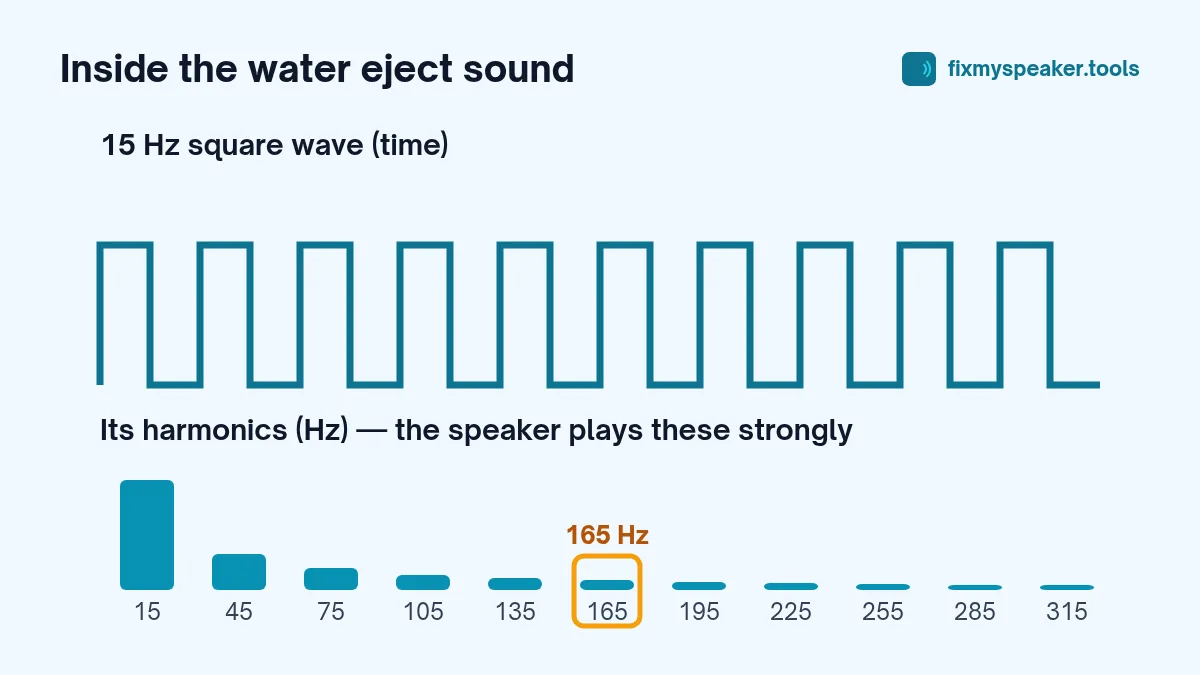
In practice, any tone in roughly the 150 to 250 Hz range works similarly on a phone. The Water Eject mode in Fix My Speaker takes a slightly different route: it plays a 15 Hz square wave. A square wave isn’t a single pure tone; it contains a whole series of odd harmonics at 45, 75, 105, 135, 165 Hz and upward. Your phone speaker can’t reproduce much at 15 Hz itself, but it plays those harmonics strongly, and the sharp on-off shape of the wave gives the diaphragm a forceful push every cycle. The result sounds like a loud buzz rather than a hum, and it covers the useful 150 to 250 Hz range all at once. If you’d rather use a pure 165 Hz tone, the Custom Hz mode lets you set exactly that.
Apple uses a similar idea in the Water Lock feature of Apple Watch, which plays tones to clear water from the speaker. That’s the only official version of this technique from a major phone or watch maker, and it confirms the principle is sound.
What it can do
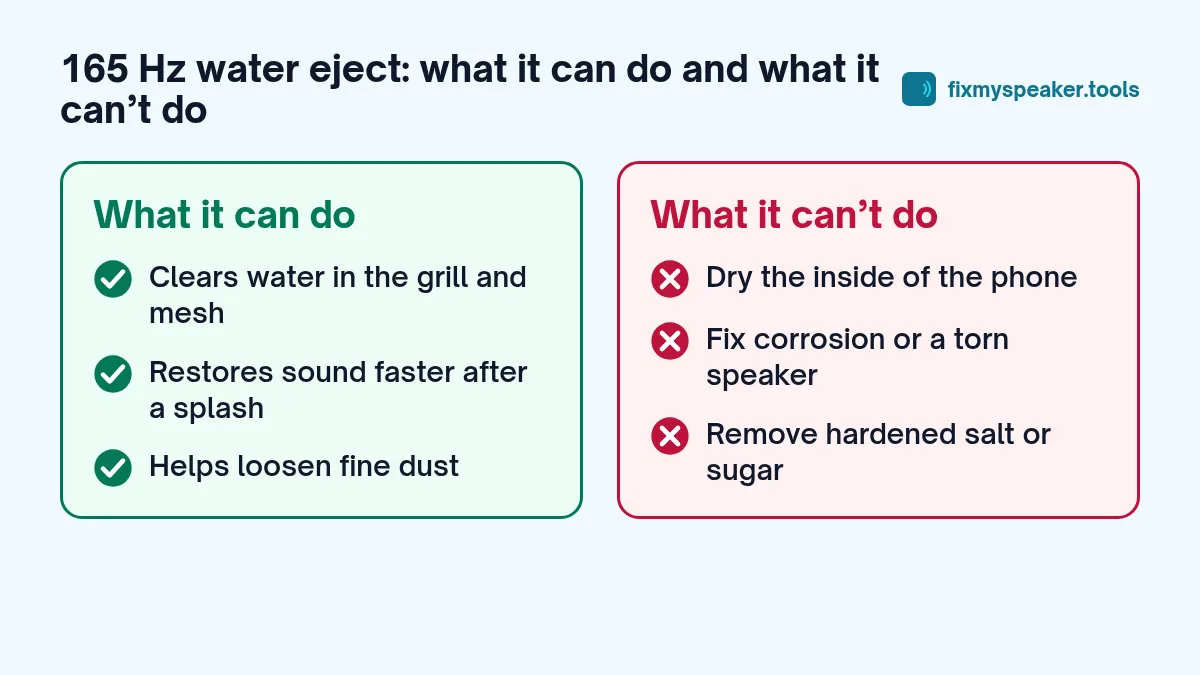
- Clear water from the speaker grille and mesh after a splash, rain or a brief dunk.
- Restore normal sound faster than waiting for the water to evaporate.
- Shake loose some fine dust, especially with a frequency sweep like the Dust Removal mode.
- Help you diagnose, because if the sound comes back to normal, you know the problem was water.
What it can’t do
- Dry the inside of your phone. Water that got past the seals into the body won’t be moved by the speaker. Only time and airflow fix that.
- Fix corrosion. If water has already caused corrosion on contacts or the board, sound won’t fix it.
- Repair a damaged speaker. A torn membrane or broken coil will still sound bad. A loud tone could make a damaged speaker worse.
- Remove hardened residue. Dried salt, sugar or soap may need gentle cleaning instead.
- Fix software problems. If your sound settings are wrong or an app is misbehaving, a tone won’t help.
Be cautious of any site that claims a sound can “repair” a speaker, “boost” it permanently or fix “all water damage”. It can’t.
Is it safe for the speaker?
Phone speakers are designed to play loud music, and a low tone at full volume for a minute or so is within normal use. Some sensible limits:
- Run it for a minute or two, a few times. You don’t need to run it for ten minutes.
- Stop if it starts to sound harsh, rattly or distorted.
- Don’t use it on headphones or earbuds in your ears.
- If the speaker is already damaged, don’t keep pushing it.
How to get the best results
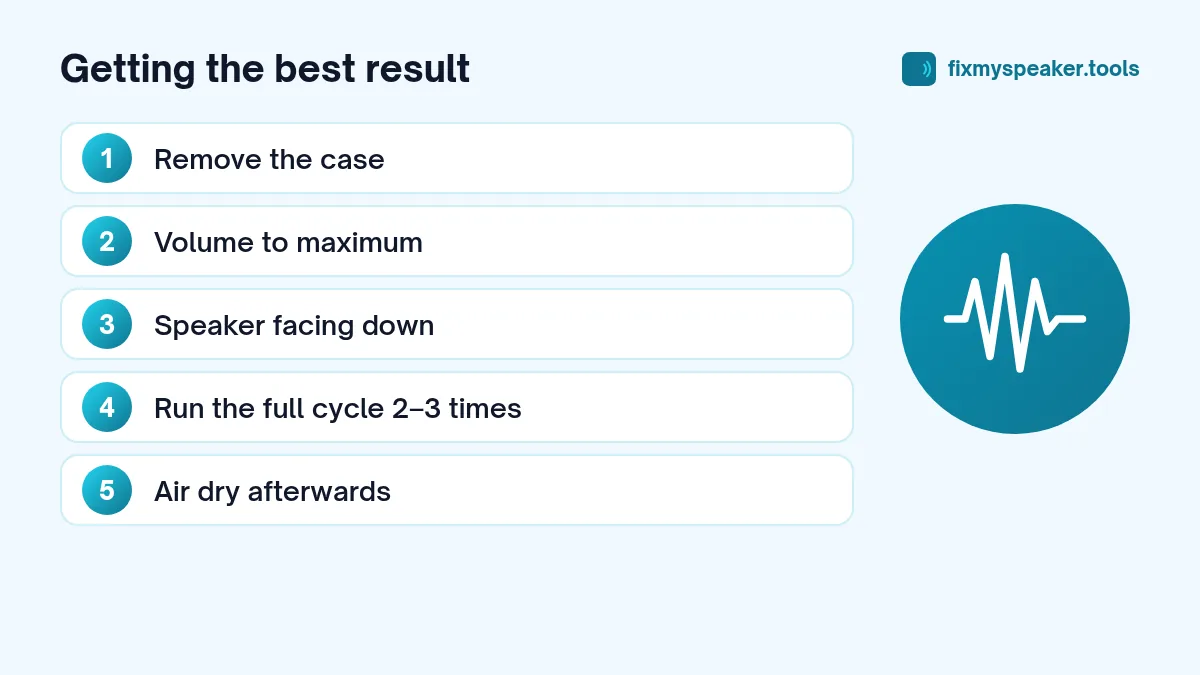
- Remove the case. It can block the grille and hold water against it.
- Turn the volume to maximum.
- Point the speaker down, so gravity helps.
- Run Water Eject for the full cycle.
- Wipe the grille, then repeat once or twice.
- Do the earpiece too, if calls sound muffled.
- Leave the phone to air dry afterwards.
When this won’t work
The tone helps only when water is sitting in the speaker opening. It won’t help when:
- The speaker was already damaged by a drop.
- Water reached the inside of the phone and is causing problems elsewhere, like a flickering screen.
- The opening is blocked by dried residue, which needs gentle cleaning instead. See how to clean dust from a phone speaker grill.
- The sound problem is caused by settings or Bluetooth.
Frequently asked questions
Does a pure 165 Hz tone work better than the square-wave buzz?
Both work on the same principle. A pure tone concentrates its energy at one frequency, while the square-wave buzz spreads it across many low harmonics at once. If you’d like to compare them, run Water Eject first and then Custom Hz at 165 Hz, and see which clears your speaker faster.
Why does the water eject sound seem so loud and harsh?
A square wave has sharp edges that produce a buzzing sound. That’s normal. If it sounds rattly or distorted rather than buzzy, lower the volume a little or stop.
Can I hurt my hearing with this?
The tone comes from a phone speaker at arm’s length, which is similar to loud music. Don’t hold the speaker against your ear, and never play it through earbuds or headphones in your ears.
The bottom line
A low tone is a simple, useful trick for one common problem: water sitting in the speaker grille. It doesn’t replace proper drying, and it can’t fix damage. If the sound is still bad after a few cycles and a day of drying, the issue is likely something else. Read why your phone speaker sounds muffled and speaker crackling causes and fixes, or compare approaches in the iPhone Water Eject shortcut vs an online tool.